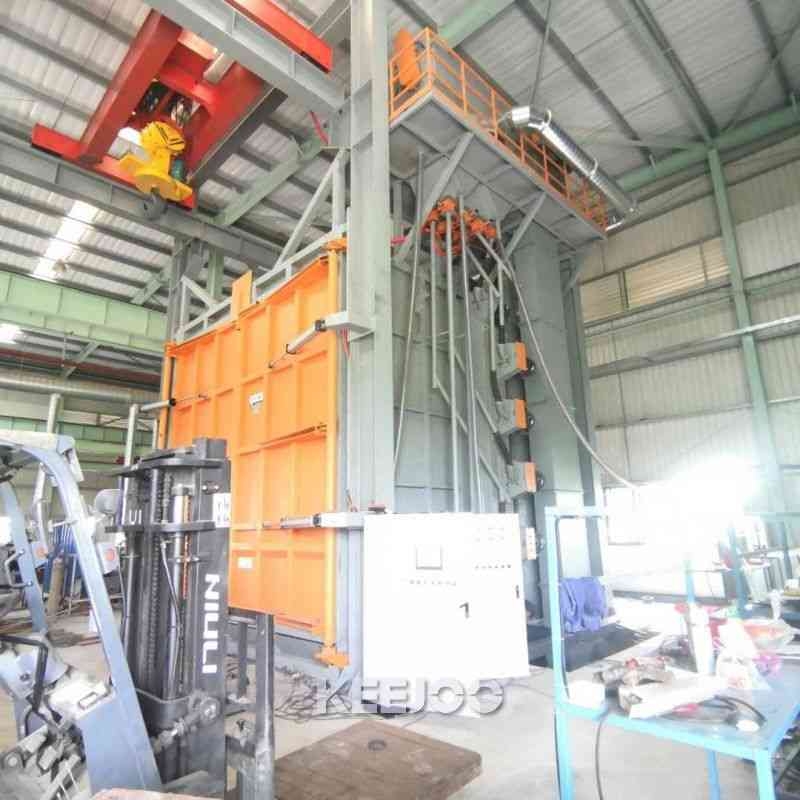
Although the surface of castings is cleaned and strengthened after shot blasting, additional processing is usually required to meet the requirements of subsequent applications, including appearance, corrosion resistance and paint adhesion. The common post-shot-blasting treatment methods are listed below:
I. Common post-shot-blasting surface treatment processes
Cleaning and Drying
Residues such as steel shot dust and mill scale fragments may remain on the workpiece surface after shot blasting. These residues shall be removed with compressed air or water washing depending on the workpiece material, followed by thorough drying to prevent rusting.
Chemical treatment (e.g. passivation, phosphating, chromate conversion coating)
A dense chemical conversion film is formed on the surface of cast iron, cast steel or aluminum alloys to boost corrosion resistance and paint adhesion.For instance, chromate conversion coating produces a colored film layer with both decorative and anti-corrosion properties.
Heat treatment (for workpieces with stringent technical requirements)
This process eliminates residual stress produced during shot blasting and stabilizes the metallographic structure.For special materials such as high manganese steel, water quenching can be applied to retain austenitic material properties.
Mechanical finishing (e.g. grinding, polishing, sandblasting)
If the surface roughness after shot blasting fails to reach the required standard, light sandblasting or grinding can be performed to achieve a more even surface finish.Non-peening sandblasting is widely used to adjust surface gloss or remove partial burrs.
Protective coating treatment (e.g. electrophoresis, spray coating, impregnation sealing)
Electrostatic spraying / Electrophoretic coating: Forms a uniform paint film to improve both appearance and corrosion resistance.
Impregnation treatment: For die castings with micro-porosity, resin sealants are used to fill tiny pores and enhance gas tightness.
II. Important considerations
How to avoid peeling defects
If thin surface layers bulge or peel off after shot blasting, the root causes are casting defects (cold shuts, gas pores) or improper process parameters (excessive shot speed, overly long blasting time). Under such circumstances, shot blasting parameters need optimization or the casting process shall be improved.
Material compatibility
Various alloys (aluminum, magnesium, titanium alloys) are sensitive to specific processing techniques, so matching processes must be selected. For example, iron-containing blasting abrasives must not be used when processing titanium alloys.
Regulatory compliance and environmental safety
Chemical treatments such as acid pickling and chromating must comply with environmental protection regulations; hence these processes are being gradually phased out and replaced at present.
III. Recommended process flow (typical applications)
Shot blasting / Cleaning →Air blowing / Water rinsing →DryingSelect subsequent procedures according to specific demands:
Pre-painting process: Phosphating or passivation
High corrosion resistance demand: Electrophoretic coating or spray painting
Sealing and tightness demand: Impregnation sealing treatment