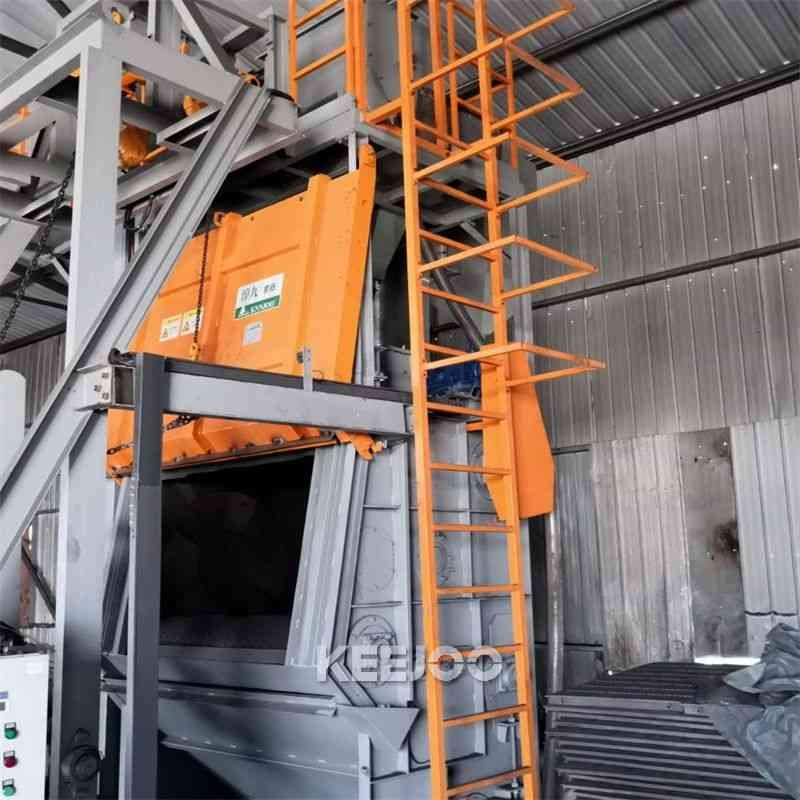
Main Causes of Incomplete Shot Blasting Cleaning
Abrasive-Related Issues
Improper abrasive size: Oversized abrasive cannot reach recessed areas; undersized abrasive delivers insufficient impact force.
Excessively worn, rounded or fractured abrasive: Reduced impact energy.
Insufficient abrasive feed rate: Low abrasive coverage density on workpieces.
Abrasive mixed with dust, sand and other contaminants: Degrades blasting performance.
Blasting Turbine (Shot Head) Malfunctions
Low abrasive ejection speed, slipping drive belt.
Worn distributor wheel and control cage: Excessive clearance causes scattered abrasive flow and incorrect blasting angle.
Severely worn turbine blades: Lower abrasive outlet velocity.
Unsuitable blasting angle and coverage: Deflected abrasive trajectory leaves dead zones on workpieces untouched.
Process & Workpiece Conveying Problems
Excessively fast workpiece transport speed leads to too short blasting dwell time.
Complex workpiece geometry with grooves, blind spots and cavities that lie outside the effective coverage of blasting turbines.
Abrasive Recycling & Dust Separation System Failures
Underperforming dust collector: Recirculated dust re-deposits on workpiece surfaces.
Blocked bucket elevator / screw elevator disrupts normal abrasive circulation.
Faulty screening unit: Broken abrasive fragments and impurities fail to be separated, impairing cleaning efficiency.
Intrinsic Workpiece Factors
Heavy oxide scale and rust cannot be fully removed in a single blasting pass.
Severe oil contamination on workpieces makes abrasives slide off, preventing rust removal.
Extra-hard base material requires stronger impact energy for thorough cleaning.
Operation & Maintenance Failures
Overfeeding of workpieces leads to stacking and mutual blocking.
Long-term lack of equipment maintenance; vulnerable wearing parts not replaced on schedule.
Incorrect adjustment of baffles and air volume disrupts the abrasive circulation loop.